Gallery · Nº 02
Garden of Earthly Delights
Five centuries of scholars, and still no one agrees what it means.
01
Read it left to right
paradise, appetite, and the bill…
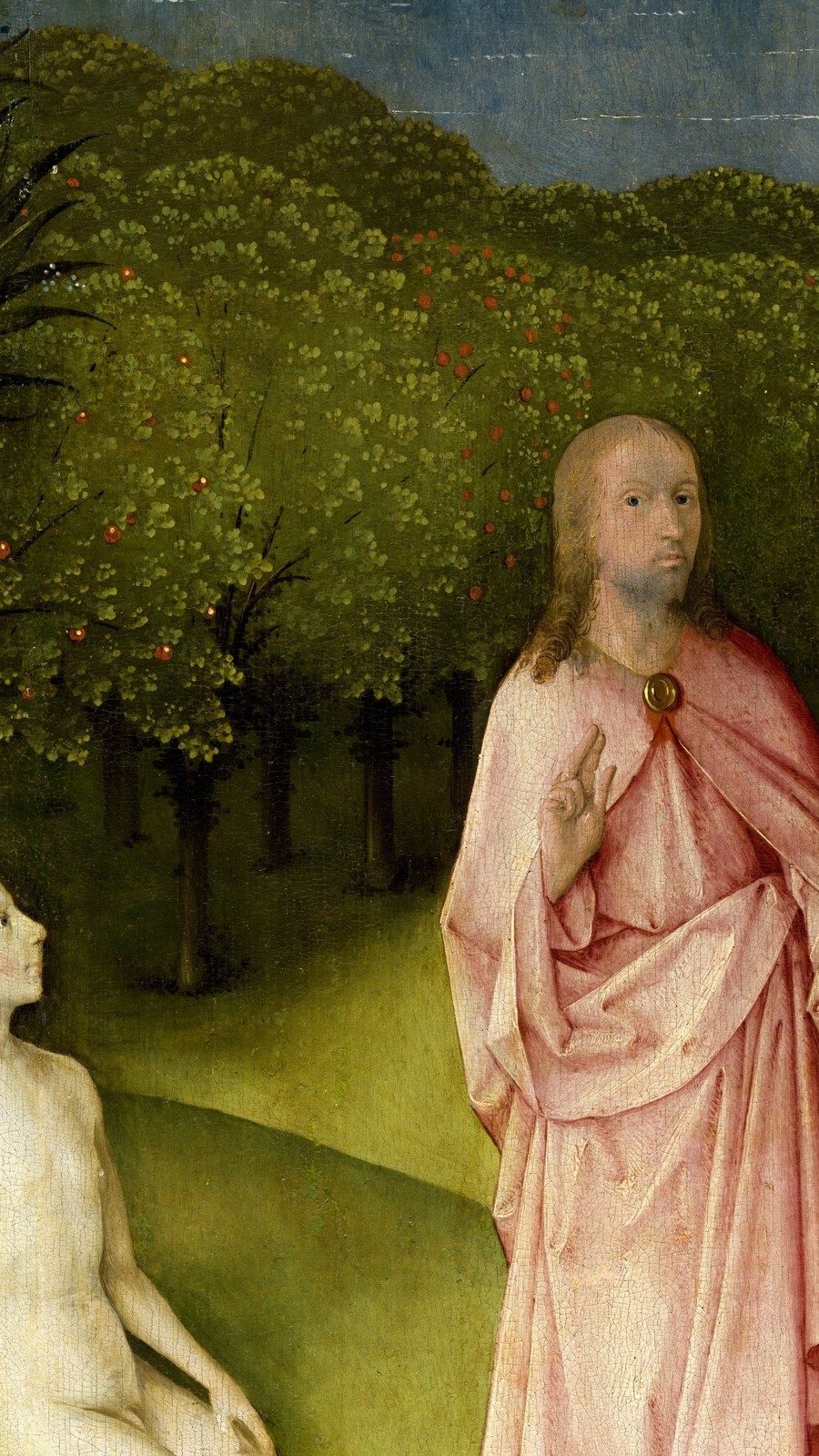
Three panels, read like a sentence. Left, Eden — God joining the first man and woman. Middle, a garden of every pleasure at once. Right, hell. Paradise, appetite, and the price, in that order.
Triptych: left panel the Garden of Eden with the union of Adam and Eve, centre the eponymous garden, right panel a hellscape. Commonly read left-to-right as a moral progression.
02
Close it, and the colour drains
because colour did not exist yet…
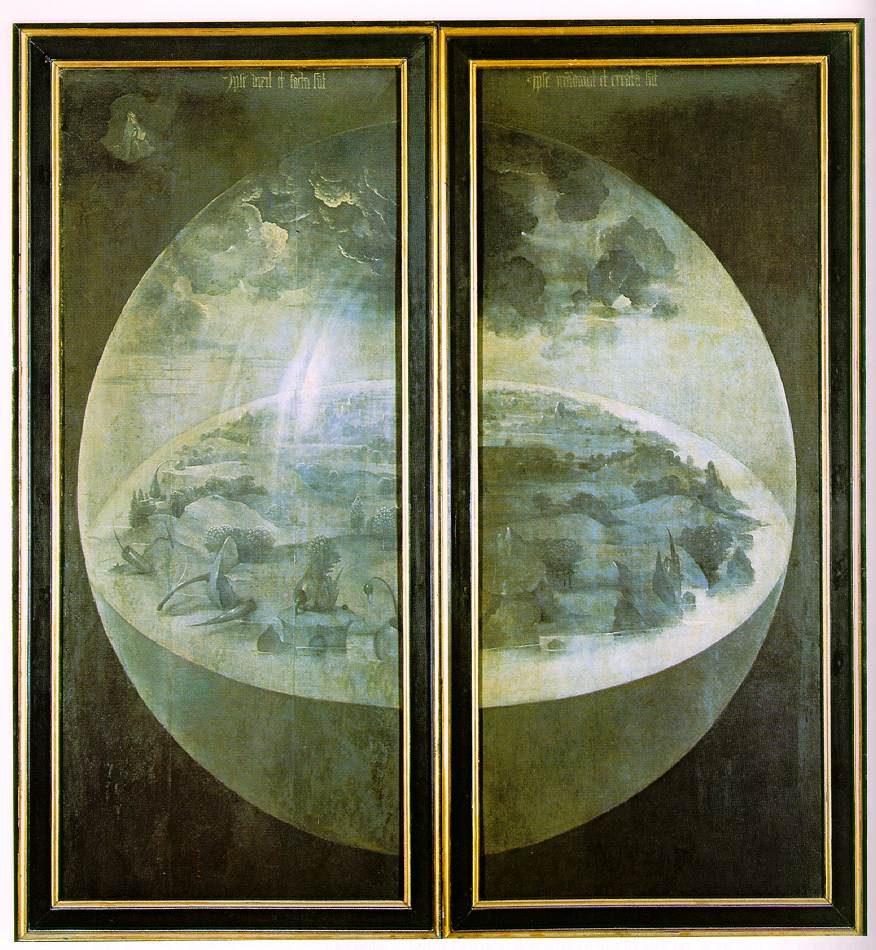
Shut the triptych and the whole thing goes grey. The closed panels show the world on the third day of creation — a flat earth inside a glass globe. It is painted in grey on purpose. In the story, the sun is not made until day four.
The exterior grisaille depicts the third day of Creation: the world as a transparent globe, in monochrome. Grisaille was conventional for Netherlandish altarpiece exteriors; here it also fits a world before the sun and moon (day four).
03
1593
and a king hung it where he slept…
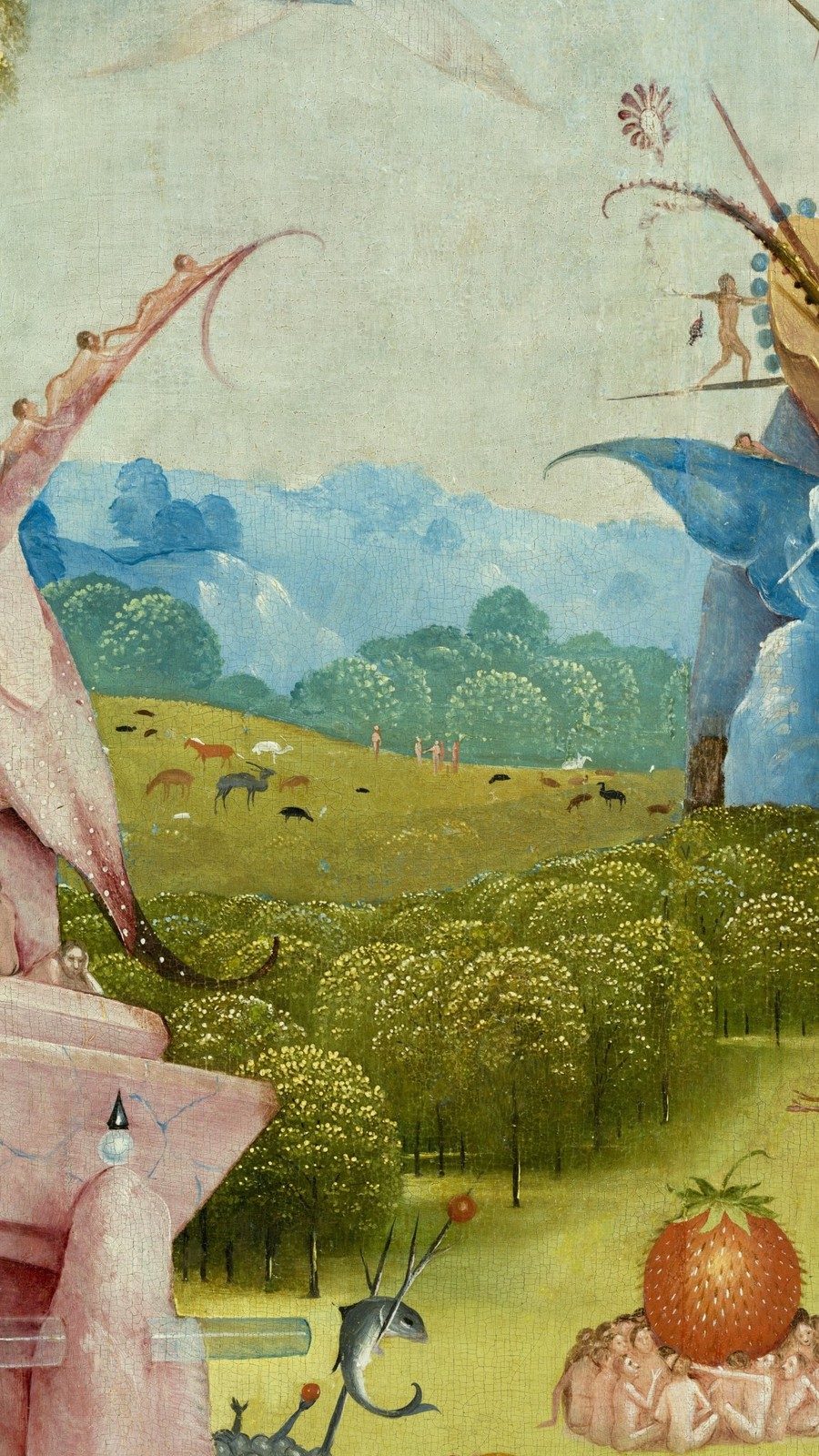
Bosch never dated it — the guesses run around fifteen hundred. What we do know: Philip the Second of Spain bought it, and in fifteen ninety-three sent the most alarming painting in Europe to a monastery, where he hung it in his own private rooms.
Undated by Bosch; dated c. 1490–1510. Philip II of Spain acquired the work in 1591 and sent it to the Monastery of El Escorial in 1593, keeping it in his private quarters. Oil on oak, 206 × 385 cm.
04
The instruments turn on you
in hell, pleasure becomes the punishment…
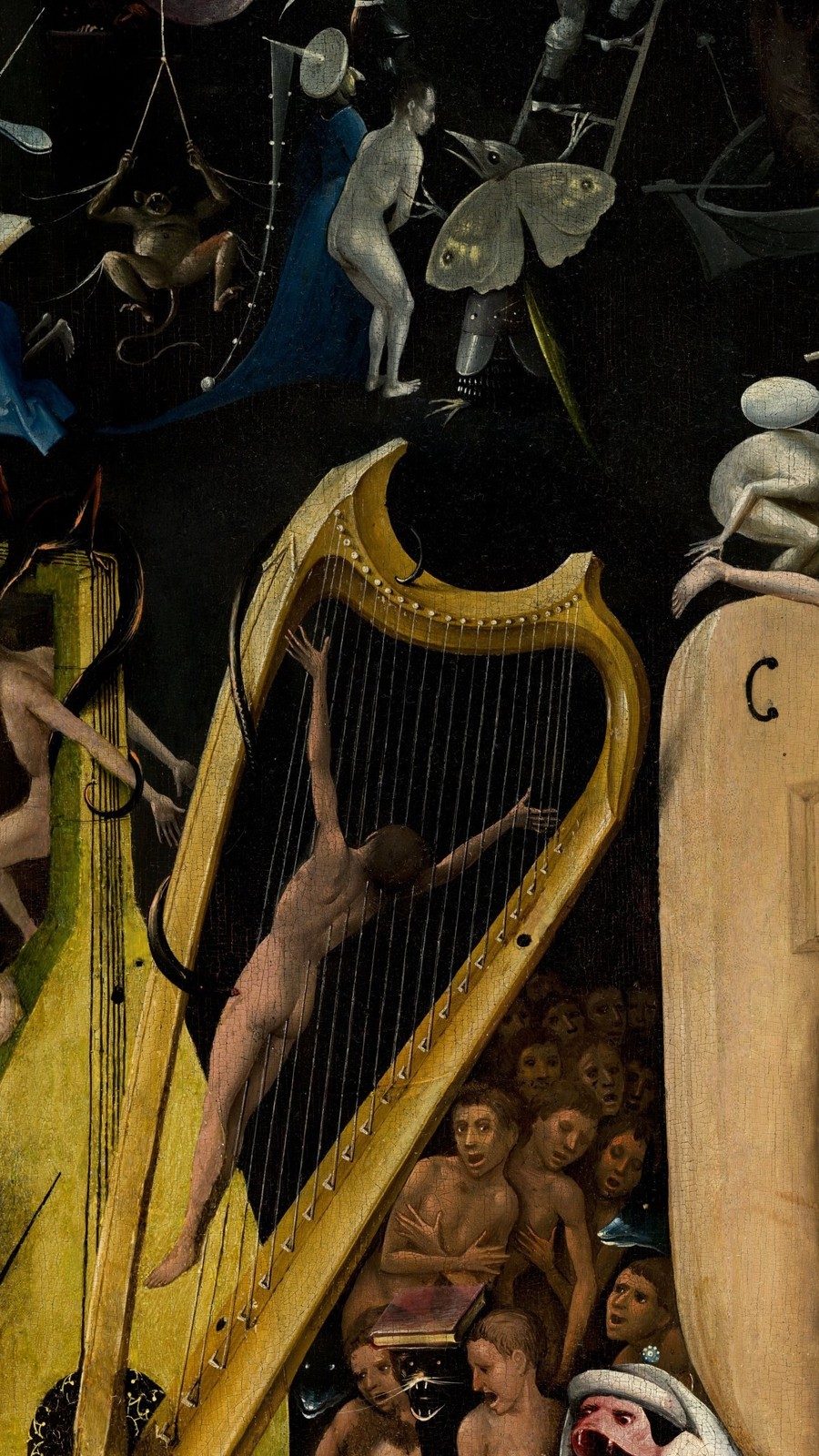
The right panel is where the pleasures come due. Bosch turns instruments of delight into instruments of torture — a man crucified across a harp, another crushed under a giant lute. What you enjoyed is what does it to you.
The right (hell) panel includes a 'musician's hell' where instruments become instruments of torment: figures impaled on a harp and crushed beneath a lute.
05
500 years
and a student played it…
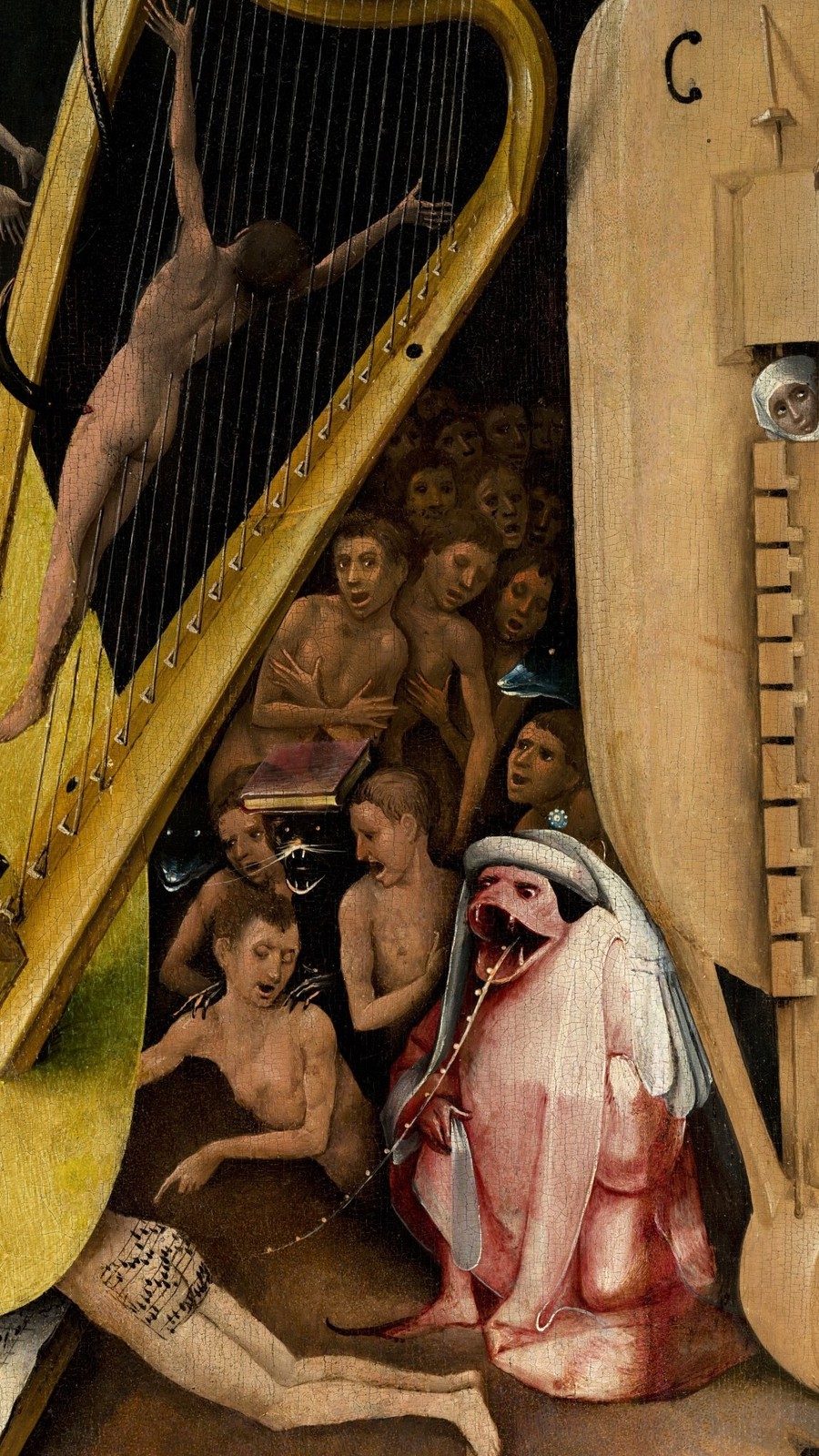
On a damned man pinned under that lute, Bosch painted lines of music across his backside. Five hundred years later a student transcribed the notes and played them. Whether Bosch meant real, readable music, or only painted the look of it, is disputed.
A figure in the hell panel bears musical notation painted on the buttocks; in 2014 a student transcribed and recorded it. Whether the notation is genuinely legible music or a depiction of music is disputed among scholars.
06
The tree-man
and some say the face is his own…
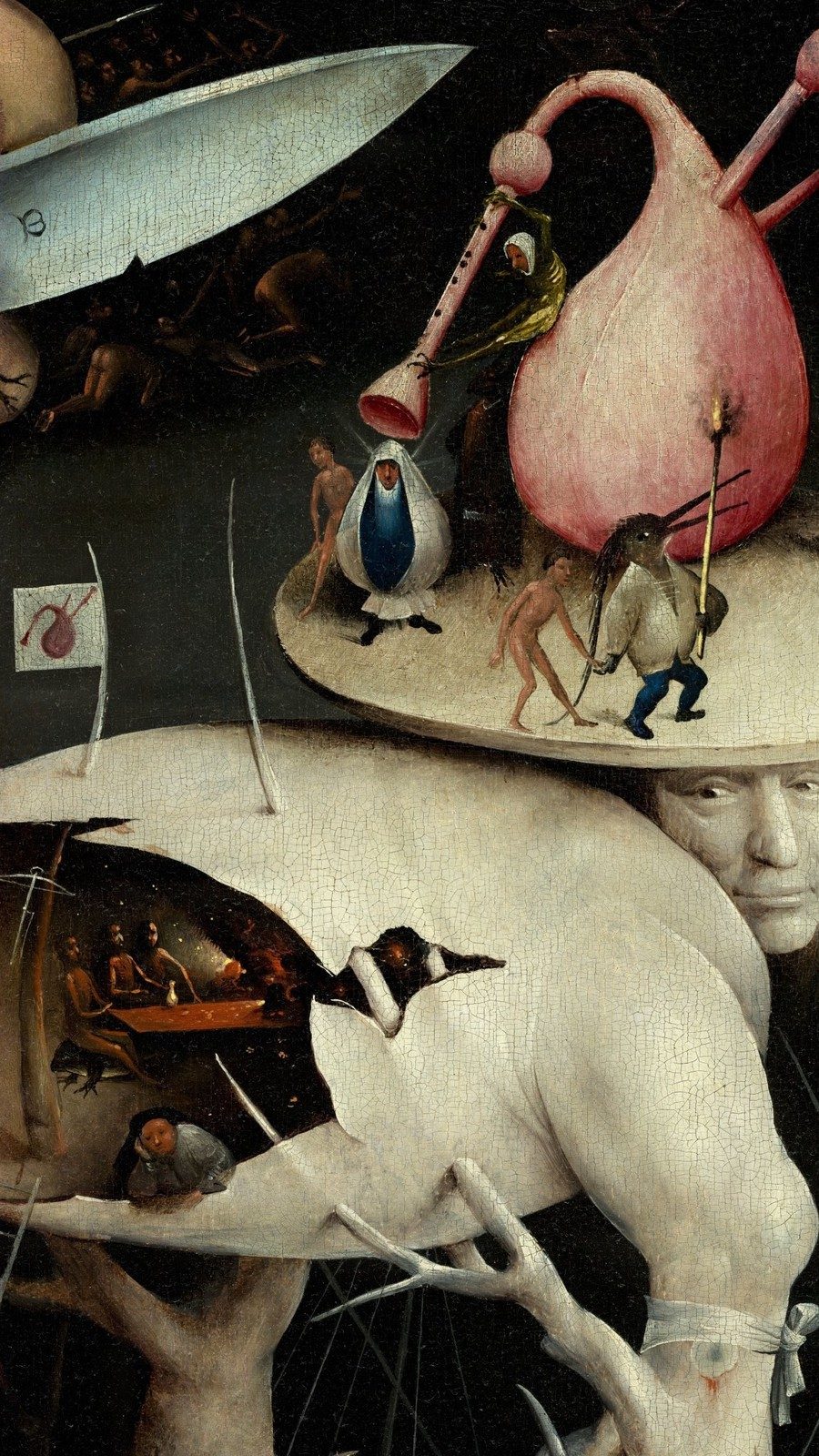
At the centre of hell stands the tree-man: a body of two dead trunks, a cracked eggshell for a torso, a tavern on his head. The face turns and looks at you. Some say it is Bosch himself, signing the worst place he painted.
The 'tree-man' in the hell panel: legs of hollow tree-trunks, a broken-egg body, a disc-shaped tavern on the head. The face has been proposed as a self-portrait of Bosch; this reading is debated and unverifiable.
07
And still nobody knows
a warning, or a lament…
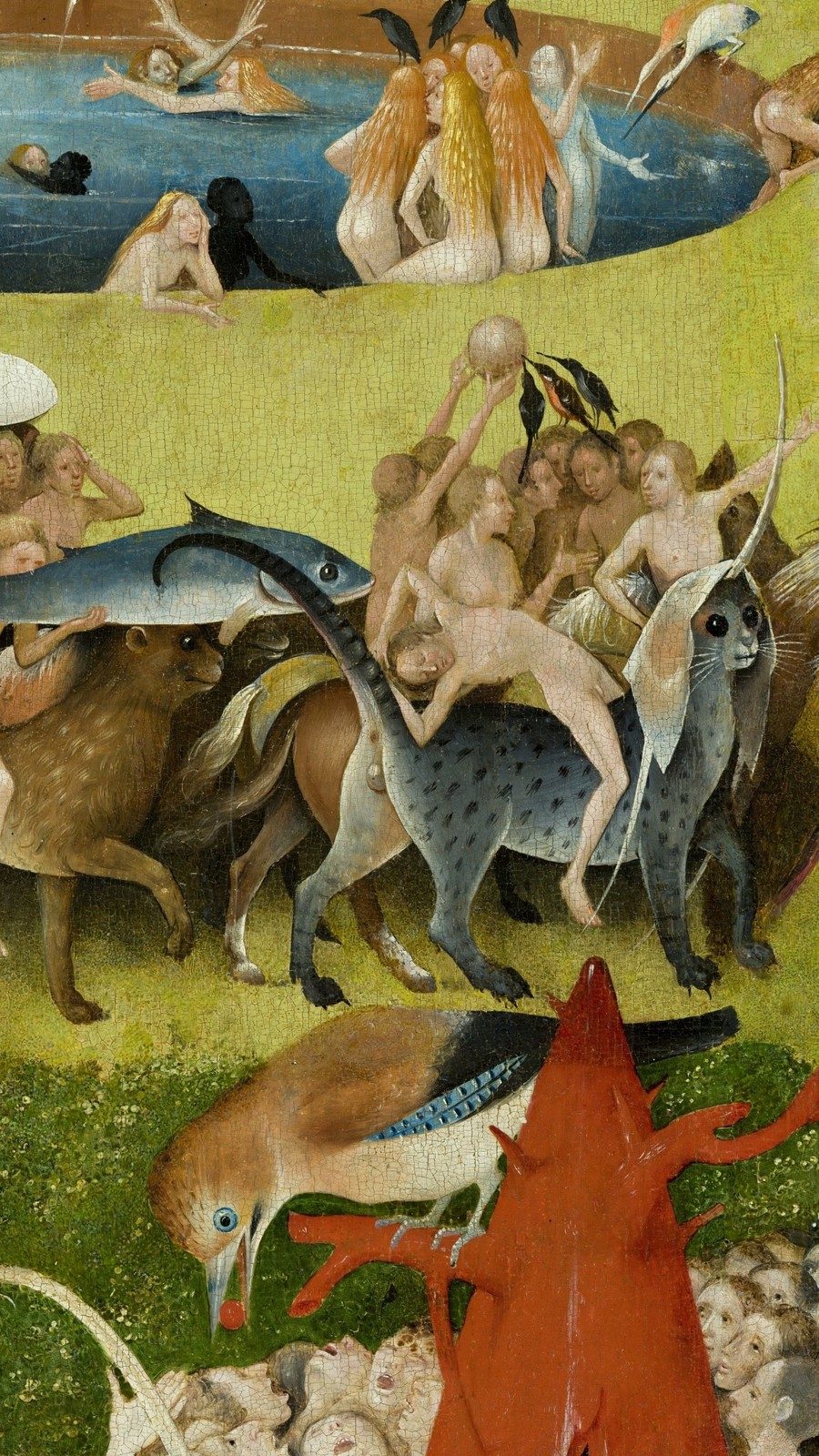
So what is it? A warning against sin, or a mourning for a paradise we threw away? A lost heresy, or a private joke? Five hundred years on, the garden keeps its secret — which may be why we cannot look away.
Interpretations range from a moralising warning against lust to a celebration of a lost paradise, with fringe theories about heretical sects. No reading is settled and Bosch left no explanation.
Sources
- Triptych: left panel the Garden of Eden with the union of Adam and Eve, centre the eponymous garden, right panel a hellscape. Commonly read left-to-right as a moral progression.
- The exterior grisaille depicts the third day of Creation: the world as a transparent globe, in monochrome. Grisaille was conventional for Netherlandish altarpiece exteriors; here it also fits a world before the sun and moon (day four).
- Undated by Bosch; dated c. 1490–1510. Philip II of Spain acquired the work in 1591 and sent it to the Monastery of El Escorial in 1593, keeping it in his private quarters. Oil on oak, 206 × 385 cm.
- The right (hell) panel includes a 'musician's hell' where instruments become instruments of torment: figures impaled on a harp and crushed beneath a lute.
- A figure in the hell panel bears musical notation painted on the buttocks; in 2014 a student transcribed and recorded it. Whether the notation is genuinely legible music or a depiction of music is disputed among scholars.
- The 'tree-man' in the hell panel: legs of hollow tree-trunks, a broken-egg body, a disc-shaped tavern on the head. The face has been proposed as a self-portrait of Bosch; this reading is debated and unverifiable.
- Interpretations range from a moralising warning against lust to a celebration of a lost paradise, with fringe theories about heretical sects. No reading is settled and Bosch left no explanation.
Image credits
- The Garden of Earthly Delights — Unknown, CC0 / public domain · Commons
- The Garden of Earthly Delights (detail) — Unknown, CC0 / public domain · Commons
- Garden of Earthly Delights — exterior (Creation) — Unknown, Public domain · Commons
- The Garden of Earthly Delights (detail) — Unknown, CC0 / public domain · Commons
- The Garden of Earthly Delights (detail) — Unknown, CC0 / public domain · Commons
- The Garden of Earthly Delights (detail) — Unknown, CC0 / public domain · Commons
- The Garden of Earthly Delights (detail) — Unknown, CC0 / public domain · Commons
- The Garden of Earthly Delights (detail) — Unknown, CC0 / public domain · Commons